Shinovar
The Way of KingsShinovar is a land at the edge of the known world whose isolation has produced an ecology and social order unlike those familiar to travelers across Roshar. Sheltered by the Misted Mountains, it is one of the few places where highstorms do not dominate daily life; its strange stillness, unfamiliar plants, absent spren, and inverted hierarchy make it both a physical refuge and a cultural challenge to outsiders’ assumptions.
Geography and Protection
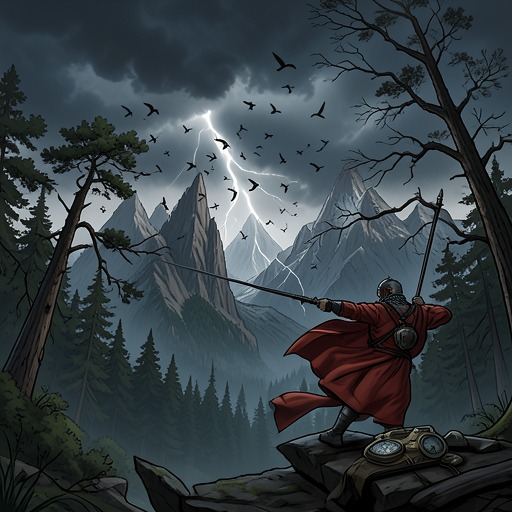
Shinovar lies beneath the white peaks of the Misted Mountains. Those mountains cause highstorms to break apart and fade before they reach the land, making Shinovar one of the only regions of Roshar where highstorms do not reign. The protection is decisive: elsewhere, weather dictates architecture, travel, labor, and survival, while Shinovar can sustain exposed fields and landscapes that would be dangerously vulnerable in storm country.
The land around the caravan is described as a plain covered in unusually thick grass. Unlike grass elsewhere, it does not withdraw when touched or beaten by strong gusts. Straight-trunked trees stand across the landscape, their stiff skeletal branches bearing leaves that likewise fail to retract from the wind. The soil appears loose and dirty, and Rysn judges that a powerful gust might uproot an entire field. Shinovar’s safety from highstorms therefore seems less a result of natural resilience than of geographic shelter: the plants behave as though they have never needed to learn the defensive habits common elsewhere.
An Unfamiliar Ecology
To Rysn, Shinovar’s landscape feels eerie and almost dead. Nothing appears to move with the quick responsiveness expected of Rosharan life, and she cannot see a single spren—not windspren, lifespren, or any other kind. The absence is not a passing detail but one of the country’s most unsettling qualities, because spren are ordinarily woven into the visible and interpretive fabric of the world.
The contrast is especially sharp when set beside the Purelake. At the Purelake, the transparent, warm, shallow water contains tiny fish, colorful cremlings, and eel-like riverspren; even a bad day there is measured through irregular tides and changing catches. Shinovar offers the opposite impression. Its grass does not withdraw, its leaves do not react, and its air seems stripped of the animated signs by which travelers understand Roshar. The country is not presented as empty, but as a place whose life follows rules so different that familiar categories of vitality become unreliable.
Social Order and Custom
Shinovar also reverses the social expectations of foreign observers. Its warriors are considered the lowliest men, treated almost like slaves. Men trade and sell warriors between houses using small stones that signify ownership, and anyone who takes up a weapon must enter this condition and receive the same treatment. Martial status, which elsewhere can confer honor or authority, functions in Shinovar as a mark of degradation.
Farmers occupy the opposite end of this hierarchy. The richly dressed man encountered by the caravan is initially assumed to be a powerful landowner, but Vstim explains that he actually works the fields and receives lavish attention and respect because he is a farmer. His fine robe does not signify aristocratic distance from labor; it reflects the esteem attached to agricultural work. Shinovar consequently makes visible how contingent social values are: the occupation that outsiders may treat as ordinary is honored, while the profession commonly associated with strength and prestige is reduced to bondage.
Contact, Trade, and Narrative Significance
Shinovar appears within a wider network of movement and exchange rather than as an entirely sealed-off land. Rysn arrives with Vstim’s caravan, which brings foreign goods for negotiation. The Shinovar representatives show particular interest in metal, and Vstim presents a heavy crate filled with scrap pieces shaped like fragments of shell and wood—objects that look to Rysn like garbage transformed through Soulcasting into metal. The delighted response to these materials reveals an active trade relationship across cultural boundaries, even where customs and landscapes remain difficult for visitors to interpret.
The country’s distance from the highstorm-centered societies of Roshar also gives it strategic and symbolic importance. It is protected from the environmental force that structures much of the continent, yet that protection has made its ecology appear passive and its customs appear strange to outsiders. Shinovar thus functions as a boundary space: familiar enough to be reached by merchants and travelers, but sufficiently different to expose the assumptions carried by those travelers.
Shinovar is also connected to the burden carried by Szeth-son-son-Vallano. He is identified as Truthless of Shinovar while working as a porter in Kharbranth, walking with a bowed back and keeping his eyes down under the sun. His shame and self-concealment attach the country’s name to an individual marked by obedience and disgrace, while the foreign city around him presents a different social and physical environment. Through this association, Shinovar becomes more than a remote homeland: it is part of the moral and political geography that shapes how its people understand duty, status, and shame.